
- Average
- R 881.72
- Lowest seen
- R 649.00
- Highest seen
- R 1 555.00
- Last change
- R 81.00
- First indexed
- 10 May 2017
- Retailer
- Loot
Description
Picture yourself in the era of discoveries: after a long voyage of great deprivation, your ships have finally reached the coast of an uncharted island. Its name shall be Catan! But you are not the only discoverer. Other fearless seafarers have also landed on the shores of Catan: the race to settle the island has begun!
In Catan (formerly The Settlers of Catan), players try to be the dominant force on the island of Catan by building settlements, cities, and roads. On each turn dice are rolled to determine what resources the island produces. Players collect these resources (cards)—wood, grain, brick, sheep, or stone—to build up their civilizations to get to 10 victory points and win the game.
Setup includes randomly placing large hexagonal tiles (each showing a resource or the desert) in a honeycomb shape and surrounding them with water tiles, some of which contain ports of exchange. Number disks, which will correspond to die rolls (two 6-sided dice are used), are placed on each resource tile. Each player is given two settlements (think: houses) and roads (sticks) which are, in turn, placed on intersections and borders of the resource tiles. Players collect a hand of resource cards based on which hex tiles their last-placed house is adjacent to. A robber pawn is placed on the desert tile.
A turn consists of possibly playing a development card, rolling the dice, everyone (perhaps) collecting resource cards based on the roll and position of houses (or upgraded cities—think: hotels) unless a 7 is rolled, turning in resource cards (if possible and desired) for improvements, trading cards at a port, and trading resource cards with other players. If a 7 is rolled, the active player moves the robber to a new hex tile and steals resource cards from other players who have built structures adjacent to that tile.
Points are accumulated by building settlements and cities, having the longest road and the largest army (from some of the development cards), and gathering certain development cards that simply award victory points. When a player has gathered 10 points (some of which may be held in secret), he announces his total and claims the win.
Catan has won multiple awards and is one of the most popular games in recent history due to its amazing ability to appeal to experienced gamers as well as those new to the hobby. In 2015, it was formally renamed Catan to better represent itself as the core and base game of the Catan series.
In Catan (formerly The Settlers of Catan), players try to be the dominant force on the island of Catan by building settlements, cities, and roads. On each turn dice are rolled to determine what resources the island produces. Players collect these resources (cards)—wood, grain, brick, sheep, or stone—to build up their civilizations to get to 10 victory points and win the game.
Setup includes randomly placing large hexagonal tiles (each showing a resource or the desert) in a honeycomb shape and surrounding them with water tiles, some of which contain ports of exchange. Number disks, which will correspond to die rolls (two 6-sided dice are used), are placed on each resource tile. Each player is given two settlements (think: houses) and roads (sticks) which are, in turn, placed on intersections and borders of the resource tiles. Players collect a hand of resource cards based on which hex tiles their last-placed house is adjacent to. A robber pawn is placed on the desert tile.
A turn consists of possibly playing a development card, rolling the dice, everyone (perhaps) collecting resource cards based on the roll and position of houses (or upgraded cities—think: hotels) unless a 7 is rolled, turning in resource cards (if possible and desired) for improvements, trading cards at a port, and trading resource cards with other players. If a 7 is rolled, the active player moves the robber to a new hex tile and steals resource cards from other players who have built structures adjacent to that tile.
Points are accumulated by building settlements and cities, having the longest road and the largest army (from some of the development cards), and gathering certain development cards that simply award victory points. When a player has gathered 10 points (some of which may be held in secret), he announces his total and claims the win.
Catan has won multiple awards and is one of the most popular games in recent history due to its amazing ability to appeal to experienced gamers as well as those new to the hobby. In 2015, it was formally renamed Catan to better represent itself as the core and base game of the Catan series.
Similar products
 −11%
−11%Catan
Catan (6th Edition) Core Family Board Game
4.9(47)R 815.00R 917.81

Amazon
CATAN Zip Travel Board Game – Portable CATAN Strategy Game with 50 Maps, Compact Carry Bag, Dice Shaker & Storage Boxes, Fun for Family & Adults, Ages 10+, 3-4 Players, 1 Hour Playtime
3.9(37)R 649.95

Loot
Catan: Junior
R 1 249.00
CATAN
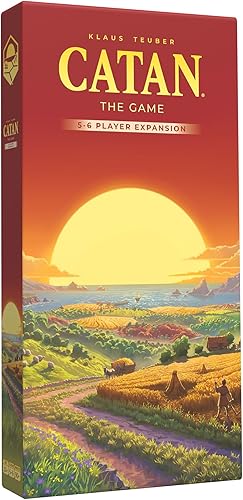
CATAN Expansion - 6th Edition - A Board Game by Catan Studio | 5-6 Players | 90 to 120 Minutes of Gameplay | Games for Family Game Night | for Kids and Adults Ages 10+ | English
4.7(465)R 529.00

CATAN
Catan CN3025 Junior Board Game for 2-4 Player
R 2 145.00

Catan
Catan (6th Edition) Seafarers 5-6 Player Expansion
5.0(1)R 695.00

Catan
Catan - Zip!
R 599.00

Catan
Catan (6th Edition) Explorers & Pirates 5-6 Player Expansion
R 835.00

Catan
Catan (6th Edition) Traders & Barbarians Expansion
R 1 389.00

Amazon
Catan (6th Edition) - Seafarers Expansion
4.6(188)R 1 159.00

Catan
Catan (6th Edition) 5-6 Player Expansion
5.0(15)R 539.00

Catan
Catan (6th Edition) Traders & Barbarians 5-6 Player Exp
R 689.00