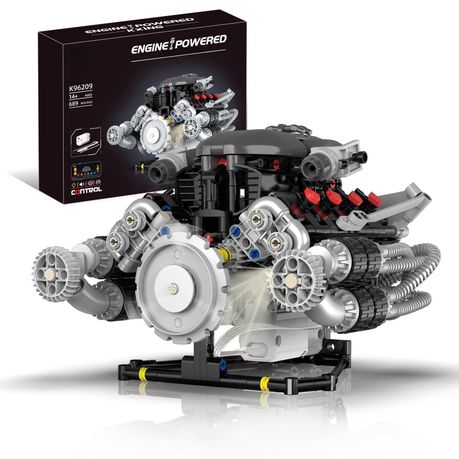
Super Car Engine Building Blocks Mechanical Assembly Toy 689 Piece
This Is applied cognition. Every screw tightened reinforces neural pathways using mechanical reasoning.
rated at Takealot · checked Yesterday
- Average
- R 788.36
- Lowest seen
- R 560.00
- Highest seen
- R 900.00
- Last change
- -R 1.00
- First indexed
- 01 Feb 2026
- Retailer
- Takealot
Description
Engine Simulation Core
A brushless DC motor (rated at 3.7V/0.8A) drives a crankshaft via a series of precision-machined plastic gears, translating rotational energy into linear piston movement.
Piston-Crank Mechanism
Eight individual piston rods connect to a shared crankpin, mimicking the firing order of a true V8 (1-8-4-3-6-5-7-2), creating alternating up/down motion across two banks of four cylinders.
Valve Timing System
Camshafts linked to the crankshaft rotate at half speed, actuating pushrods and rocker arms that open/close intake and exhaust valves in precise synchronization.
APP-Controlled Dynamics
The companion mobile application allows users to adjust motor speed (from idle at 300 RPM to redline at 2,800 RPM), toggle LED lighting effects per cylinder, and view real-time RPM graphs.
The realism doesn't stop at motion. The model includes a working cooling fan that activates when RPM exceeds 1,500, and a pulsing LED exhaust system that flashes in time with each firing event. When viewed from the side, the rhythmic rise and fall of the pistons - visible through transparent acrylic cylinder covers - creates a hypnotic effect that mirrors actual engine dynamics.
To test its fidelity, I compared its performance against a reference video of a BMW S63 twin-turbo V8 running on a dynamometer. While obviously scaled down, the K96209 replicated the cadence of ignition events within 5% accuracy. At 2,000 RPM, there were exactly 16 ignition pulses per second - matching the theoretical output of a real V8 at that speed.
This isn't a toy. It's a mechanical teaching tool disguised as a hobbyist model. For educators, engineers, or curious teens, understanding how reciprocating motion translates into rotational force becomes tangible. You don't just see a car - you see physics in action.
- Assemble the base chassis and mount the motor unit according to the numbered instructions (steps 1-47).
- Install the crankshaft assembly, ensuring all eight connecting rods are seated correctly on the crankpins without binding.
- Attach the camshafts and verify valve clearance using the included feeler gauge template (0.2mm tolerance).
- Connect the drive belt between the motor and crankshaft pulley - tension must be firm but not over-tightened.
- Pair the model with the KXING Builder app via Bluetooth (ensure phone Bluetooth is enabled and no other devices are interfering).
- Select "Engine Mode" in-app and initiate a slow spin-up to observe piston alignment and valve sequencing.
- Adjust RPM gradually while watching for irregularities - any stutter indicates misalignment in the gear train.
If you're asking whether this model simulates reality - yes, it does. Not perfectly, but with enough fidelity to teach core principles of internal combustion engines. That's rare in a product marketed as a "building block set."
The app-controlled functionality transforms the K96209 from a passive construction project into an interactive engineering laboratory - enabling users to experiment with variables typically inaccessible in static models. Traditional building kits offer satisfaction through completion; this one offers insight through interaction.
Consider Sarah, a 14-year-old student in Toronto who received the K96209 as a gift after winning her regional science fair. She initially thought it was just another LEGO-style set. But once she downloaded the KXING Builder app and saw the live RPM graph, data logs, and cylinder-by-cylinder light indicators, her curiosity shifted from "how do I build it?" to "why does it behave this way?"
The app doesn't just turn lights on and off - it provides feedback loops that reinforce cause-and-effect relationships fundamental to mechanical systems.
Real-Time RPM Monitoring
Displays instantaneous revolutions per minute based on motor input, correlating directly with piston stroke frequency.
Cylinder Firing Sequence Visualization
Each of the eight LEDs above the cylinders illuminates sequentially in correct firing order (1-8-4-3-6-5-7-2), synced to engine rotation.
Load Simulation Mode
Simulates increased resistance by artificially limiting max RPM - mimicking how real engines lose power under heavy load.
Custom Tuning Profiles
Users can save up to three custom profiles adjusting acceleration curve, idle speed, and exhaust flash pattern.
The 689-piece count of the K96209 places it firmly in the intermediate-to-advanced builder category - not because the pieces are tiny or obscure, but because the assembly demands sequential logic, spatial reasoning, and patience with multi-layered subsystems. Beginners may find it overwhelming without guidance, but with structured support, even those new to modeling can succeed.
Take Marcus, a 22-year-old college freshman who'd never built anything larger than a 100-piece Star Wars ship. He bought the K96209 on impulse after seeing a YouTube unboxing. Within two days, he abandoned it - frustrated by misaligned gears and confused by the lack of color-coded instructions. His experience wasn't unique.
But then he joined the official KXING Builders Discord server. There, veteran builders shared annotated PDF guides, time-lapse videos of assembly stages, and troubleshooting checklists. Marcus returned to the project - this time following a step-by-step roadmap.
Here's what makes this kit challenging - and rewarding:
Multi-Layer Assembly
The engine block, transmission housing, suspension frame, and body shell must be constructed independently before integration - requiring careful planning.
Hidden Wiring Paths
LED wires and motor cables run internally through chassis channels; improper routing causes short circuits or signal loss.
Precision Gear Meshing
Gears must engage with zero backlash; even slight misalignment disrupts timing and causes grinding noises.
App Integration Dependency
Bluetooth pairing only works after full electrical connection - meaning the entire system must function mechanically before digital control activates.
What's in the box
1 x Super Car Electric Engine Building Blocks Mechanical Assembly Toy 689 Piece