
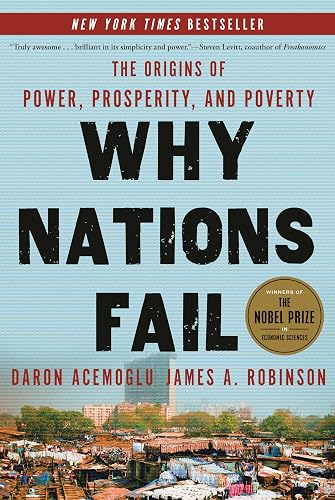
Why Nations Fail: FROM THE WINNERS OF THE NOBEL PRIZE IN ECONOMICS: The Origins of Power, Prosperity and Poverty
R 183.15−25%
Amazon · checked 8 days ago
3 offers · 3 retailers
Best price PriceFind tracks
No other tracked retailer beats this price. Compare every offer
- Average
- R 305.00
- Lowest seen
- R 183.15
- Highest seen
- R 305.00
- Last change
- -R 121.85
- First indexed
- 20 Sep 2026
- Retailer
- Amazon
Amazon Cheapest
Why Nations Fail: FROM THE WINNERS OF THE NOBEL PRIZE IN ECONOMICS: The Origins of Power, Prosperity and Poverty
Checked 8 days ago
ViewR 183.15
- View
R 305.00
+R 121.85
- View
R 388.00
+R 204.85
Each price is from PriceFind's last check of that retailer. Follow the link for the live price.
Description
BY THE NOBEL PRIZE-WINNING ECONOMISTS DARON ACEMOGLU & JAMES A. ROBINSON Shortlisted for the Financial Times Business Book of the Year Award Why are some nations more prosperous than others? Why Nations Fail sets out to answer this question, with a compelling and elegantly argued new theory: that it is not down to climate, geography or culture, but because of institutions. Drawing on an extraordinary range of contemporary and historical examples, from ancient Rome through the Tudors to modern-day China, leading academics Daron Acemoglu and James A. Robinson show that to invest and prosper, people need to know that if they work hard, they can make money and actually keep it - and this means sound institutions that allow virtuous circles of innovation, expansion and peace. Based on fifteen years of research, and answering the competing arguments of authors ranging from Max Weber to Jeffrey Sachs and Jared Diamond, Acemoglu and Robinson step boldly into the territory of Francis Fukuyama and Ian Morris. They blend economics, politics, history and current affairs to provide a new, powerful and persuasive way of understanding wealth and poverty. Read more
Similar products

Loot
Why Nations Fail
R 722.00

Loot
Why Nations Fail
R 481.00
Amazon
Why Nations Fail: The Origins of Power, Prosperity, and Poverty
R 261.64

Takealot
A Nation Worth Building
R 345.00

Loot
Divided Nations
R 283.00

Takealot
How Nations Fail and the Unmaking of America's World
R 1 329.00

Takealot
Changing World Order
5.0(5)R 675.00

Takealot
Exam Nation
R 439.00